

Guide 1: How to implement a centralized cash management system
“…Payroll hits tomorrow, and Location A is $10,000 short. Location B has $40,000 sitting idle. Location C just drained its buffer replacing a fridge. Three restaurants, three bank accounts, and one owner, scrambling late at night to make the math work.”
Sound familiar? If so, you’re not alone. I talk to mid-sized multi-unit restaurant owners who’ve built good businesses and recognizable brands, with millions in revenue, but still feel constant stress around cash flow. The contradiction is real: you’ve built something successful, yet you’re still worried about making payroll.
The reality is that most mid-sized multi-unit owners still manage cash flow manually: constant transfers, late-night bank logins, and back-of-the-envelope notes for the CPA. It’s exhausting, and it doesn’t scale.
And here’s the thing: this isn’t just a problem for underperforming locations. Even if you’re hitting sales targets and managing prime costs well, this is a low-margin business. Without the right systems, you’re just one slow month or one equipment breakdown away from panic.
That’s why I care about this so much as a financial advisor to restaurant owners. At the business level, consistent cash management creates stability: bills are paid on time, payroll goes out without having to scramble, and you always know your true cash position. That stability is what makes it possible to take consistent personal distributions. And those distributions are the fuel for your personal wealth building. Without stability in the business, you’ll never have predictability in your personal financial life. Without predictability in your personal financial life, it’s almost impossible to build lasting wealth.
The solution? Implement a centralized cash management structure that takes you out of reaction mode and gives you visibility and predictability of cash flows across all your units. That’s what this guide is about.
What This Guide Explains
- The Problem: Why fragmented cash management is expensive, stressful, and limiting.
- The Solution: How centralized cash management (using zero balance accounts / sweep accounts) actually works.
- Outcomes: What this feels like for you as an owner.
- FAQs: Straight answers to the questions you’re probably asking right now.
- Implementation Guide: 7 practical steps to set this up.
- Advisor Questions: Exactly what to ask your CPA, attorney, banker, and planner.
- Key Takeaways.
- Appendix.
1. The Costs of Fragmented Cash Management
The biggest cost, and by far the most important, is that it prevents you from setting up a repeatable owner pay and distribution structure. Without consistent distributions, you can’t plan for personal wealth building. And this is one of the primary reasons you’re in business!
Other hidden costs:
- Surplus cash sits idle in low-interest accounts.
- You waste time moving money around manually.
- Reduced flexibility to weather unexpected challenges.
- Higher banking fees and minimum balance requirements.
- Poor visibility into consolidated cash position (hard to forecast).
- Less leverage with banks when negotiating credit facilities.
- Strained supplier relationships when units struggle individually.
Additionally, at a strategic level, owners often get “stingy” with underperforming locations. Now, no one but the operator knows whether that’s the right decision. But having centralized cash management will allow you to make decisions based on what’s best for the overall business and get away from the habit of reacting to the performance of one siloed unit.
2. What is a Centralized Cash Management System?
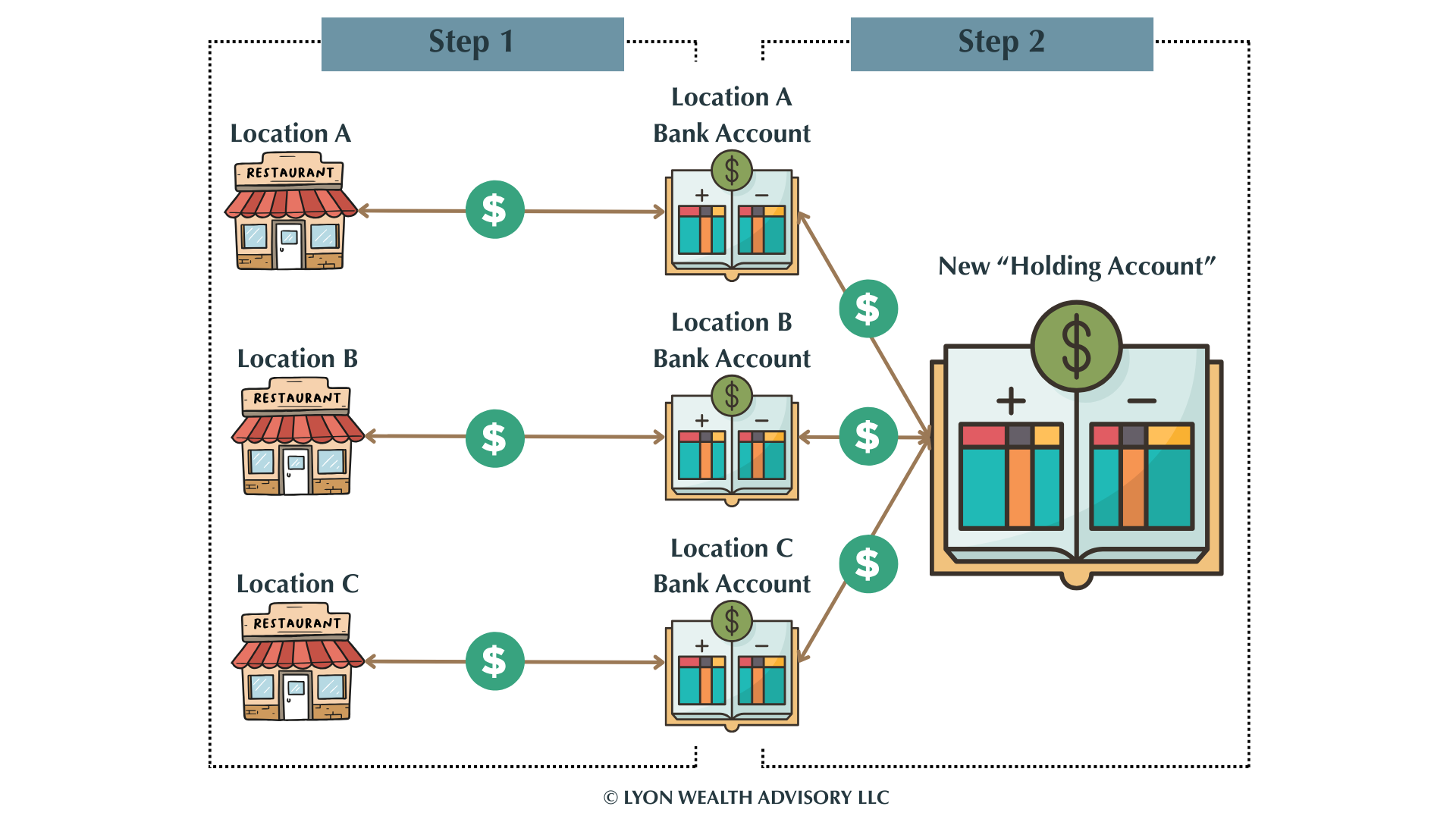
Step 1: Each restaurant keeps its own bank account for deposits and payments. No change from your current process.
Step 2: A new holding account (sometimes called a treasury account or concentration account) is added.
- At the end of each day, the bank automatically “sweeps” surplus cash from each restaurant account into the holding account. When a location needs funds, the holding account pushes cash down to the location’s account.
- A simple change to your accounting process will track how money flows so you never lose track of how much cash a location has used or provided over time (this is called “intercompany accounting” and it’s a very well established accounting practice).
3. Outcomes: What This Feels Like to You as an Owner
Let’s go back to that situation we started with:
- Location A won’t be able to cover payroll.
- Location B has cash sitting idle.
- Location C might make payroll, but has no buffer.
And you are stuck moving money around and hoping the timing works out.
Here’s what the exact same situation looks like with a centralized cash management system in place:
- Instead of three disconnected balances, you log in and see one consolidated number in the holding account. You know exactly how much cash you have to work with.
- Payroll for Location A? Covered automatically. The bank sweeps funds down from the holding account without you lifting a finger.
- The $40K that was sitting idle at Location B? Now it’s working for the whole business, not just one unit.
- The emergency fridge replacement at Location C? It doesn’t send you into a tailspin because you already know your overall cash position can absorb it.
The difference is night and day. You move from:
- Constant firefighting, then: Automated movement between entities.
- Making assumptions about how much cash each location is generating or using, then: True visibility across all locations.
- Inconsistent owner pay, then: Reliable distributions you can plan your personal life around.
- Weak banking leverage, then: Stronger credit terms thanks to consolidated balances.
- Messy intercompany transfers, then: Clean accounting records.
- Being unable to predict cash balances in the future, then: Having the data you need to build sensible cash flow forecasts so you can prepare for shortfalls in advance.
5. How to Implement: 7 Steps to Centralized Cash Management
1. Talk to Your CPA/Bookkeeper First
Sit down with them and explain why this matters: “I need to know where I stand with cash, I want predictable distributions, and I don’t want to be up at night moving money between accounts.”
Your CPA’s role is to make sure intercompany transfers are recorded correctly, so you don’t run into tax or audit issues. If you create a management company, it will also file its own tax return. That adds some complexity and cost, but it also opens up meaningful planning opportunities.
A good CPA should see this as a chance to clean up your books and build new tax strategies. And remember, you don’t have to make this complicated from day one. If your priority is stability, you can keep it simple now and discuss planning opportunities later.
2. Review Your Entity Structure
Most likely each of your locations already has its own legal entity; nothing changes there. But forming a management company entity (e.g., MgmtCo LLC) to own the holding account is usually the cleanest way to run this system. It keeps one unit from “holding” another’s money and creates flexibility for tax planning.
3. Design the Account Structure with Your Banker
Meet with your banker to design the setup. Not all banks offer zero balance accounts (ZBAs) or sweeps, so bring this document if you need to explain what you’re trying to achieve.
If you consider changing banks for this (or any other reason) here’s a lesson from COVID: you want a bank sophisticated enough to provide these kinds of services, but small enough that you know the staff personally. When PPP loans rolled out, the operators who had a first-name relationship with their banker got their applications processed first. That kind of relationship matters.
4. Get the Legal Docs Right
Update operating agreements and intercompany agreements so this setup is allowed and documented. This isn’t about changing ownership, it’s about making sure your agreements reflect how cash actually moves.
5. Set Up the Accounts
Open the new accounts at your bank and update your account structure in your bookkeeping software. If you do your own books, there are plenty of resources on intercompany accounting. If not, make sure your bookkeeper is confident in this area, or reach out to me for input.
6. Train Your Team, Maybe
For most managers, nothing changes: they’ll still see deposits, pay vendors, and run payroll the same way. The only difference is that end-of-day balances sweep out, and cash is deposited to cover expenses, automatically. If you have a manager handling higher-level approvals or cash flow, give them a simple one-page SOP so they know the process.
7. Monitor & Optimize
After the first few months, check what’s changed: lower banking fees, better visibility, consistent distributions. Once things are stable, consider adding enhancements like interest-bearing sweeps. This is where the system starts to shift from just “helpful” to a true wealth-building engine.
6. Questions to Ask Your Advisors
Here’s what to ask when you meet with your advisors. These questions will get you educated on the key aspects of this process (as it will be slightly different depending on your situation, state, and advisor choice) and help your advisor remember everything they need to do on their side:
CPA
- When cash moves between my locations and the holding account, how should we record it?
- Do we need to change anything in my entity structure to make this more efficient?
- How will this setup impact my QBI deduction? Or other tax planning strategies we have in place?
Attorney
- Do my operating agreements need to be updated to allow this?
- Will this change my liability protection?
- What documents do we need so my partners feel comfortable?
Banker
- What’s the most cost-effective sweep or ZBA structure you offer?
- Can consolidating balances improve my loan terms?
- Can we set up an interest-bearing account so idle cash works harder?
Financial Planner
- How do I structure consistent distributions now that cash flow is stable?
- How should I align my retirement contributions and investments with this system?
- If I plan to sell a unit, how does this setup impact valuation and exit planning?
- What should I do with the money I’m going to be saving?
7. Key Takeaways
Think back to how cash flow feels today: late-night transfers, sticky notes for your CPA, constant stress about whether payroll will clear.
Now picture the alternative:
- You log in and see one clear number that represents the cash position of your entire business.
- No fire drills to cover major expenses.
- You forecast your cash balance and identify potential issues ahead of time.
- You pay yourself consistently, not just “when there’s something left.”
- Your banker sees you as a stronger, more professional operator.
That’s what centralized cash management delivers: stability for the business, predictability for your income, and a chance to focus on building wealth.
Appendix: Additional Tax Planning Strategies (with a Management Company)
So, one could write several blogs on the tax planning opportunities that exist when you create a management company.
If you do independent research on this, be careful of non-licensed internet charlatans who suggest outrageous ideas. You should only be taking advice on this subject from a CPA, Attorney, or Enrolled Agent (note that I am an Enrolled Agent, as well as a CFP®, and you can read more about what an Enrolled Agent is, below).
That being said, the establishment of a management company in a restaurant group, if it’s done for a substantial business purpose, does create opportunities for legitimate tax planning strategies. Here’s a high level non-exhaustive list of ideas that a management company (and their tax advisor) could consider:
- Management fees: Deductible at the restaurant level, income at MgmtCo.
- S-Corp optimization: Salary + distributions to reduce self-employment tax.
- Fringe benefits: Retirement plans, health benefits sponsored by MgmtCo.
- QBI optimization: Better balance of wages/income across entities.
- Asset protection: IP/trademarks owned by MgmtCo, licensed back.
What is an Enrolled Agent?
An enrolled agent is a person who has earned the privilege of representing taxpayers before the Internal Revenue Service. Enrolled agent status is the highest credential the IRS awards.
Enrolled agents, like attorneys and certified public accountants (CPAs), have unlimited practice rights. This means they are unrestricted as to which taxpayers they can represent, what types of tax matters they can handle, and which IRS offices they can represent clients before.
This article is general information for restaurant owners. It is not individualized tax, legal, or investment advice.