

Guide 2: How to make investment decisions as a restaurant owner
How To Make Investment Decisions: How This Guide Will Help You Build Personal Wealth
- Capital is precious: Restaurants are capital-intensive, low-margin businesses. New dollars are hard to come by, and it takes a lot of them to launch a project. That means every opportunity to invest has to count.
- The default is rapid growth: Too many owners expand obsessively until fatigue or setbacks force them to sell or cutback. That’s typically the opposite of how lasting wealth is built.
- Confidence and perseverance matter: Jumping straight from “I have cash” to “I’m investing” often leads to second-guessing yourself down the road.
A framework will help you spend your dollars thoughtfully, make decisions that are better aligned with your goals, and give you conviction and staying power when (not if) things get tough. You won’t avoid every mistake, but you’ll stay consistent over time, and that’s what builds wealth.
Our Framework
This is the framework we use to help clients evaluate what to do with their excess cash or what to do when they’re considering investing in a project. We’ll review each step in detail.
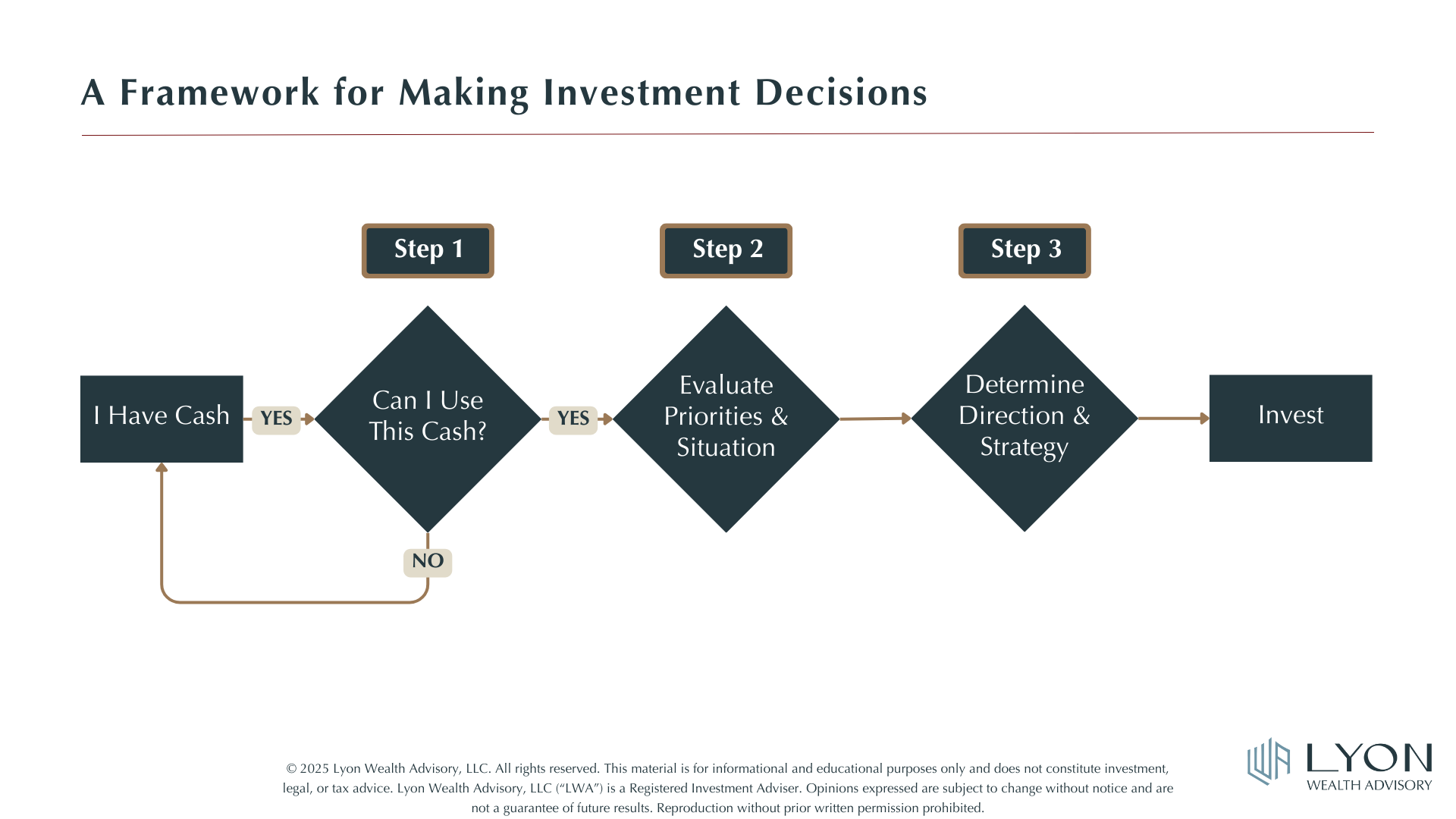
Step #1. Can I Use This Cash?
The question we’re asking here is: Can I afford to use this cash and still have sufficient cash on hand to manage my business? Here are 3 rules of thumb for making this decision:
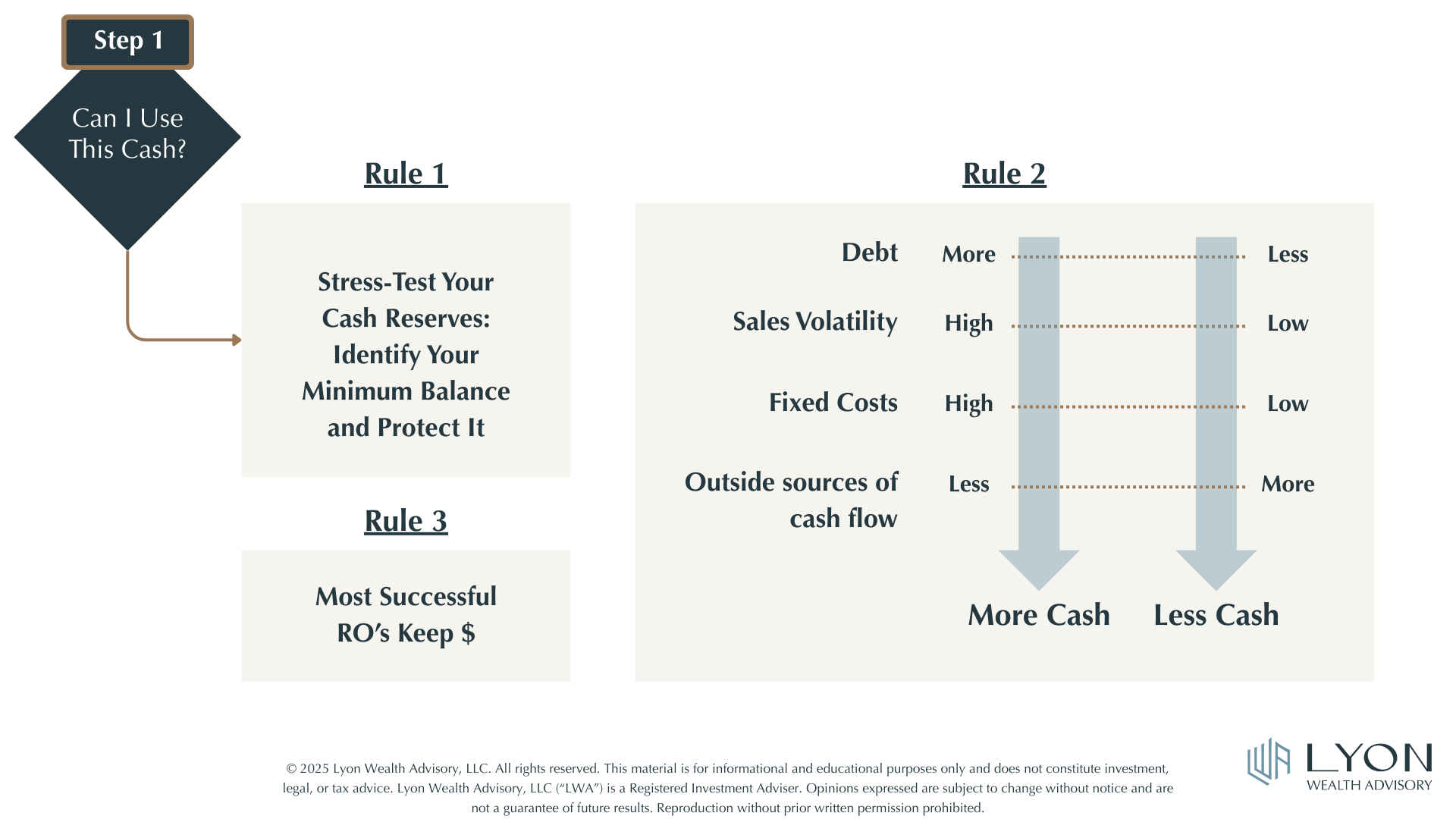
Rule 1: Stress test to find your minimum cash reserve balance and don’t go below it. I sometimes call this your “sleep-well number”. To do this, you’ll calculate how much cash you need to have on hand to survive an economic downturn or unexpected losses across your businesses.
- Model business cash needs: Start by calculating how much cash your restaurants would need to continue operations under a few scenarios (e.g., assume a 10% and 25% revenue reduction over 6 months and 1-year).
- Calculate personal cash needs: Next, you’ll need to calculate how much cash you need to cover your personal spending (because we’ve assumed we can’t draw funds from the businesses) over a similar period of time.
- Account for outside income cautiously: You’ll want to factor in outside sources of cash flow as a reduction of the cash you need, but be careful if you rely heavily on rental payments you’re making to yourself through owner-occupied real estate.
- Include all fixed obligations: Be sure to incorporate all the fixed financial obligations you have (e.g., debt payments, lease obligations, other fixed expenses, etc) at the personal and business levels in your calculations.
- Add a buffer: If you lean toward overconfidence, pad the numbers you calculate.
- Combine totals: Add the necessary cash amounts together. This is the approximate amount of cash you and your family need to survive the downturn period.
- Test assumptions: Then ask, does the scenario and number of months feel like the right scenario analysis? Should you be more or less aggressive with the downturn scenario? Adjust as needed and recalculate.
- Compare and summarize: Compare the final amount of cash needed with the amount you have on hand. If you have less on hand than what you need, consider building cash reserves before investing. If you have more on hand than you need, summarize your reserve target clearly (e.g., “We need ~$200,000 to operate and to live normally for 12 months assuming a 25% revenue drop”) and move on to the next rule.
A note about cash on hand: a solid percentage should be actual cash in high-yield accounts and business and personal operating accounts. But a percentage can certainly be non-cash liquid assets (for example, investment accounts). You would just want to haircut the value in calculating your “cash on hand” position (for example, you might include 60% of your investment account value, assuming at least 50% of your required cash on hand is in actual cash accounts, in determining your total cash on hand.
The goal is not to be perfect here, but to get a good feel for what you can work through with your existing cash reserves and whether you can invest some of your excess cash.
For context, at LWA, we develop a consolidated analysis of our clients entire financial profile, both business and personal, and then stress-test cash positions against different risks. This helps right-size reserves based on our client’s risk tolerance and financial situation. One significant benefit of doing it this way is that because we look at everything on a detailed level, we can often identify tax savings opportunities that we can use if we experience a downturn.
Rule 2: There are factors that make it more or less important to keep more cash on hand. Restaurant owners with more debt, higher sales volatility, higher fixed costs (in absolute terms), and limited outside sources of income should hold more cash. This is logical, but it’s also mathematically true: most of these factors increase your sales breakeven number. The higher your breakeven number, the less sales must decline for you to start losing money in any given time period.
Rule 3: Most long-term successful restaurant owners keep more cash on hand than others believe. This rule is as simple as it sounds. Successful operators know that in order to thrive you have to survive our industry’s downturns.
Important: Holding cash isn’t inefficient. Forget any advisor who’s told you otherwise. In restaurants, cash is what keeps you in the game. Now, you absolutely need to make sure you’re investing your cash balances in accounts that earn the highest possible return. I’ll discuss how to do this in a future how-to guide.
Step #2. Evaluate Your Priorities & Situation
Next, you need to consider your personal priorities and business situation before deciding where you’re going to invest:
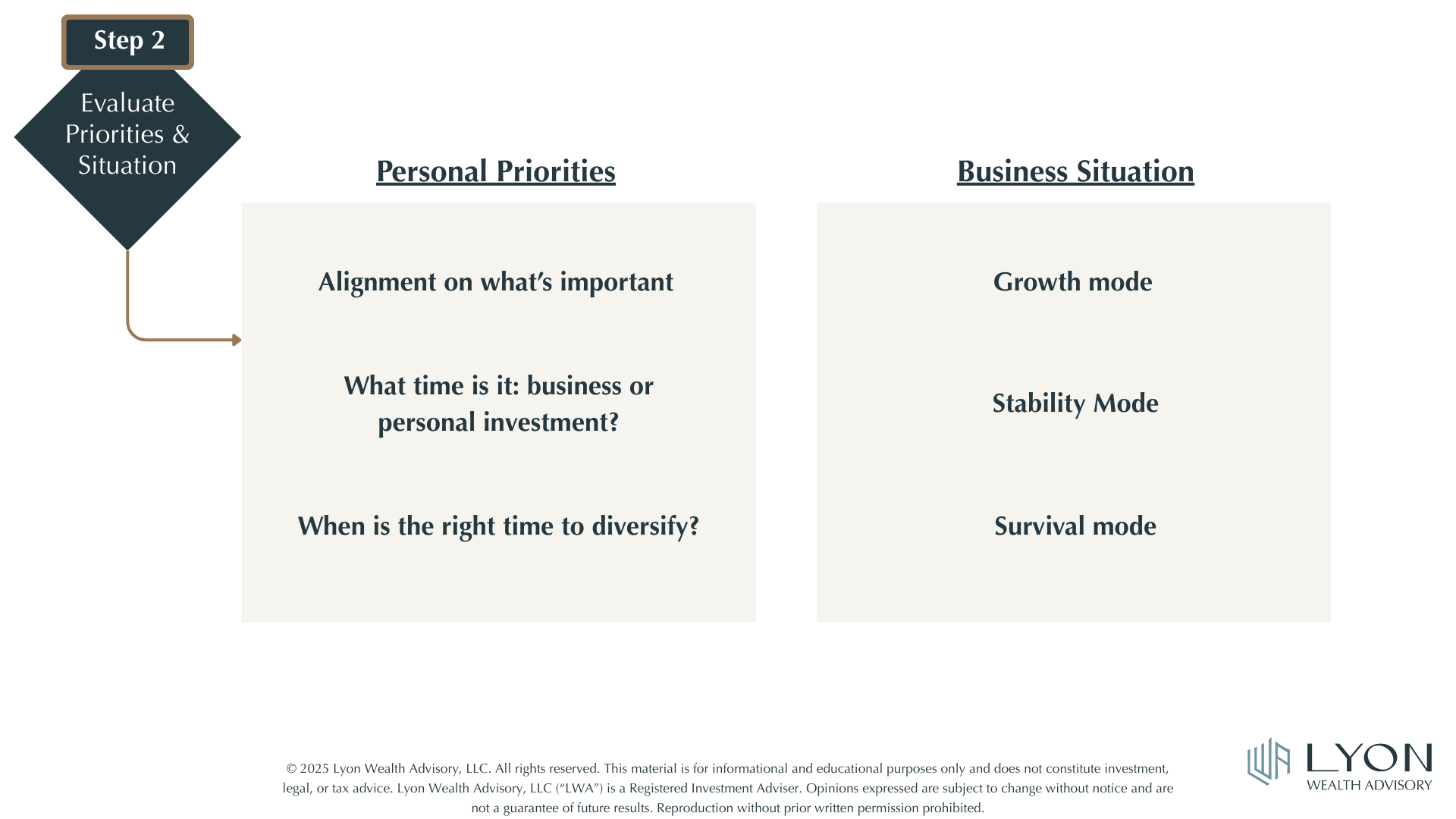
Personal Priorities:
- Family alignment: Talk with those impacted by your business decisions about what’s most important right now.
- Balance business vs. personal: Sometimes it makes sense to double down on growth. Other times, personal investments (travel, family, health) can’t be deferred. Personal investments create memories that can’t be replaced, while business investments may create future opportunities. The art is balancing both.
- When is the right time to diversify: If you want to retire, you will eventually need to build wealth outside your restaurants. It would be extraordinarily rare for a restaurant sale (not including real estate) to fund 10, 20, or 30 years of retirement income on its own. So this should be a major consideration in your evaluation of what to do with your excess capital. Consider this example: even if you sold at 5x cash flow, and assume no capital gains tax drag or selling expenses, you need to invest your entire sales proceeds, and earn a 20% return, to generate the approximate level of income that you had as a restaurant owner!
Business Situation:
- Growing: Growth requires reinvestment, but remember: as you scale, risk can compound. Consider this carefully as you consider how much debt you’re willing to take on.
- Stability: If you’ve built a business you enjoy and it’s generating strong income, your focus may have shifted. At this stage it’s common to overspend personally and become complacent. If this is your case, pause, appreciate what you’ve created, and consider how you might protect what you’ve built through investing in your business or by beginning to diversify your wealth.
- Survival: There are seasons in this industry where the goal is simply to make it through. These downturns can also create opportunities (like a prime location suddenly coming available) so consider those if you’re very well capitalized. Of course, you’ll want to consider whether it would be better to preserve your cash until the economic environment has improved.
How You Can Implement This Step: A good practice for multi-unit owners is to create an investment priority statement: Before evaluating any investment opportunity, use the above questions to brainstorm and write down your answers to these three questions: (1) What does financial success look like for our family in 10 years? (2) What trade-offs are we willing to make today to achieve that vision? (3) What would we regret not doing now? Keep this one-page summary accessible and refer to it whenever you’re considering an investment. When an opportunity arises, ask yourself: “Does this decision move us closer to our 10-year vision, align with our stated trade-offs, and avoid creating regrets?” If you can’t answer yes to all three questions, it may be time to go back to the drawing board.
Step #3. Determine Direction & Strategy
After considering your priorities and situation, you’ll be prepared to make a decision on what direction to take and which strategy to use. You have 3 directions you can take your investment dollars: your business, your lifestyle, or diversify your wealth.
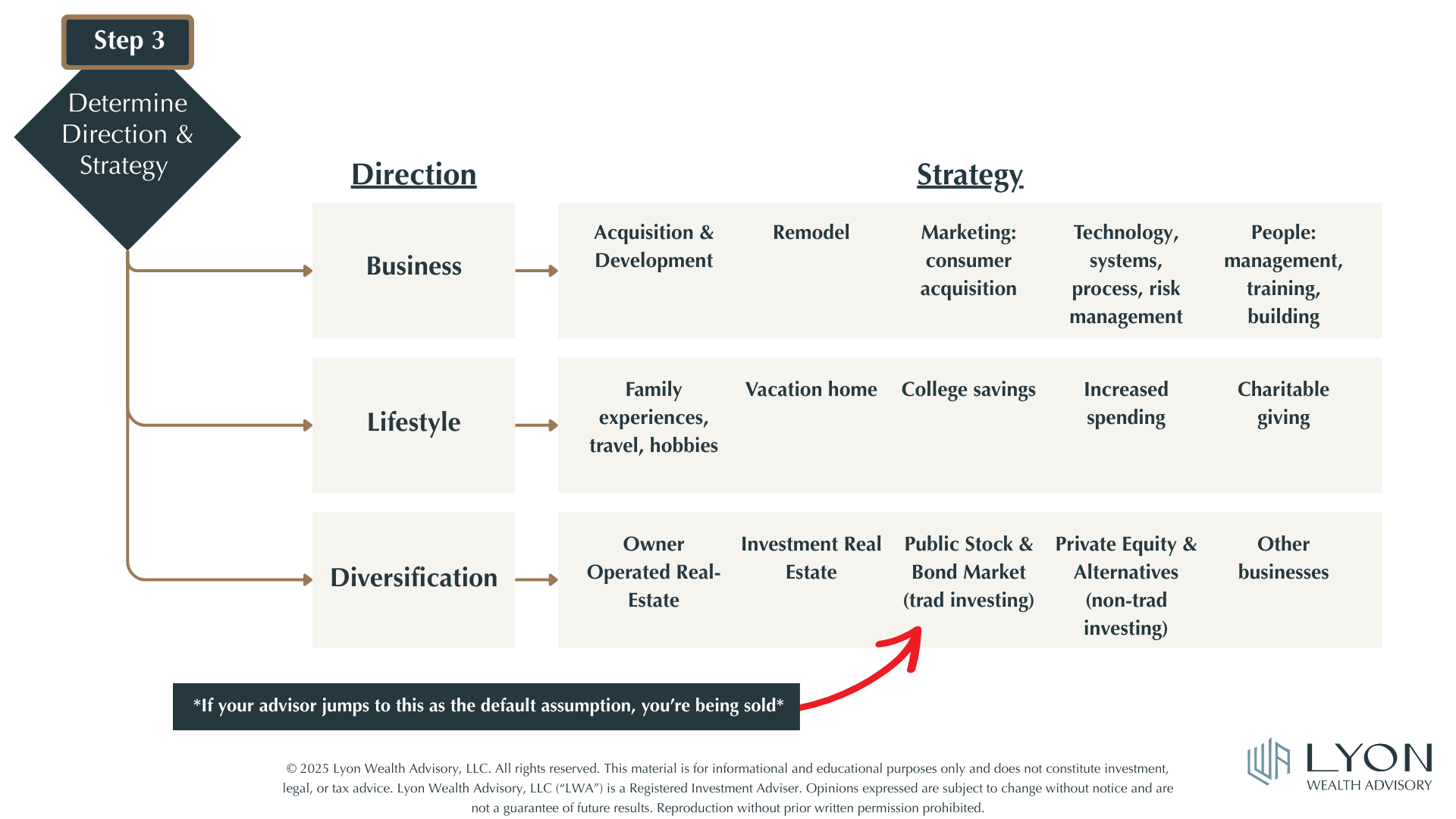
If you decide to:
- Invest in your businesses: You can acquire existing properties, develop new ones, or complete remodels on existing locations. Don’t overlook making a significant marketing push, investing in technology and systems, or investing in people development and training.
- Invest in lifestyle/family: The opportunities are limitless. As a financial advisor, if you’re considering an asset purchase, I encourage you to rent before you buy, whether that’s a boat, RV, or vacation home. These purchases often cost more time and money, and provide less long-term benefit than expected. On the other hand, it seems people have fewer regrets when spending money on memorable experiences. Just food for thought.
- Diversify your wealth: Building wealth outside your restaurants requires understanding both what you’re diversifying into and what you’re diversifying away from. Restaurant ownership offers control, tax advantages, and the potential for outsized returns, but concentrates your wealth in a single, volatile industry. Effective diversification means accepting lower control and potentially lower returns in exchange for stability and reduced concentration risk.
- This is a when, not if, question: Review the example at the bottom of page 6. You will eventually need to diversify to build wealth for retirement.
- The strategies: You’ll be choosing between owner occupied real estate, investment real estate (I separate these because the risks are sufficiently different), the stock market (think traditional investing), the private market and alternatives (think limited partnerships, private credit, private equity, crypto, etc.) and other small businesses.
- Consider owner occupied real estate: All restaurant owners should at least consider buying the real estate under their restaurants when the opportunity presents itself. There are unique risks that you need to understand and the attractiveness of the opportunity will depend on the individual parcel under consideration. But it should always be a consideration. It can diversify wealth, create tax advantages, and may give you more stability over the long run.
- Consider tax implications: The saying is true: don’t let the tax-tail wag the investment-dog. But it’s important to understand that tax impacts can contribute substantially to your return on investment. So we don’t want taxes to be the reason why we make an investment decision, but we certainly want to consider them when making an investment decision.
- Start with these principles: Diversify gradually, understand the time commitment each investment requires, and ensure any investment fits your risk tolerance and capacity. Do understand that this is a very important moment to consider getting professional advice.
- If you work with a financial advisor and their default answer is to put all excess funds into the stock market, you don’t have an advisor, you have a salesperson. For the restaurant owner, when and where to begin diversifying wealth has different characteristics than most small business owners (and certainly more than typical W2 employees). A good financial advisor will help you understand this and work with you to find an investment strategy that makes sense for you.
- Be aware: Restaurant owners are sometimes vulnerable to “can’t-miss” investment pitches. Because you work so hard for your money, it’s tempting to believe there’s an easier way. It rarely works out that way.
There’s a lot more to say about choosing a diversification strategy. I’ll address this in greater detail in future guides.
Additional considerations/discussion topics for your financial advisor:
- You should consider the full impact of any investment decision on your cash position. For example: if you buy a beach house with a $250,000 down payment and it creates a $6,000 monthly cash drag (mortgage, taxes, maintenance, extra travel), that’s $72,000 a year you need to plan for.
- You should ask your financial advisor to help you understand the potential impact of your investment decision (whether business or personal) on your financial plan under different scenarios. Seeing the outcomes inside a well-developed plan doesn’t just give clarity, it creates opportunities that are otherwise very difficult to identify. It will allow you to weigh multiple alternatives and make smarter trade-offs. Without it, decisions tend to feel two-dimensional, a simple “yes or no,” “right or left”, instead of part of a bigger strategy.
- You can include paying down debt and investing in insurance in this analysis as well. If you’re considering insurance as “an investment,” get objective advice first. Insurance is important, but it’s often inappropriately oversold as “an investment” by insurance salespeople.
- Don’t make the mistake of assuming you don’t need to worry about keeping cash on hand because you can sell an asset if necessary. Maybe, if (1) we’re not in the middle of a 2008-style asset devaluation, (2) you don’t have too much debt, and (3) you don’t encounter any other serious cash flow problems at the same time. But I would never advise it. Beyond that, the purpose of the framework is to find the best use of the cash you have available.
Putting This Framework Into Practice
Start by conducting your cash analysis so you understand how long your businesses and personal finances could survive various revenue declines. Hold a family conversation about your 10-year financial vision and document your priorities. Then begin using this three-step framework for every investment decision.
Track your decisions and their outcomes. You won’t be perfect, but consistency matters more. If you’re working with a financial advisor, insist they help you work through all three steps before recommending any investment. If they dismiss Step 1 or push you toward a default solution without understanding your priorities, find a new advisor.
Remember: the goal isn’t to optimize every decision, but to ensure your investment choices align with your broader wealth-building strategy. Restaurant ownership has taught you that sustainable success comes from disciplined systems, not perfect timing. Apply that same discipline to your investment decisions.
This article is general information for restaurant owners. It is not individualized tax, legal, or investment advice.